Posts

Networth Update 3Q 2024

Image
It's been a while since I last updated my finances. With the completion of my flat renovation and our wedding banquet successfully hosted, I have put these significant expenses behind me. I can now focus once again on building my wealth. I took this opportunity to consolidate my investments. I liquidated my positions in Stashaway and sold the cash-funded investments in my Endowus account. My funds were redeployed into an All World ETF (ISAC) and a US small-cap value ETF (USSC) through IBKR. This shift not only simplifies my portfolio but also helps reduce recurring fees. Going forward, I plan to DCA based on the following allocation: $3,000 in ISAC, monthly via IBKR $1,000 in CSPX, monthly via IBKR $1,500 in USSC, quarterly via IBKR $1,500 (SRS) in Dimensional US Core, monthly via Endowus $1,000 (CPF) in Amundi World, monthly via Endowus With these, I'm looking at a roughly 80% US 20% international portfolio with a slight tilt towards small-cap and value factors.

Net worth Update 3Q 2023

Image
CPF: $304,500 (-$79,000) The large drop in CPF was due to a downpayment for my  resale   HDB flat. Cash: $264,800  (+ $300 ) Consists of a combination of: Cash in UOB One, OCBC360 and DBS Multiplier Money market fund in robo cash management A small amount in SRS, awaiting allocation into Endowus ETFs: $111,100 (-$2,400) Both CSPX and QQQM moderated in 3Q23. Endowus: $130,800 (+17,300) My DCA portfolio for international exposure and tilt toward small cap, value, profitability and momentum. The portfolio consists Dimensional US Core Equity (25% of DCA amount) Global Core Equity  (25%) Global Targeted Value  (17%) Emerging Market Large Cap  (8%) Pacific Basin  (8%) Endowus 80% Equity 20% Bond managed portfolio (17%) Gain consists of capital injection of $18K and capital loss of $700 SG Stocks: 54,800  (-$1,900) Individual stocks with focus on dividend-paying companies. Most were purchased during my early foray into investing. Will reduce my exposure ...

The Flaws of a Dividend Investing Strategy

Image
Dividend investing is a popular strategy among investors seeking passive income. The idea of receiving regular cash payouts from investments is appealing but largely based on behavioural misconception that dividends are "free money" disconnected from capital value or share prices - a phenomenon known as the Free Dividend Fallacy   ( Hartzmark et al., 2018 ). The Dividend Disconnect To begin, it's crucial to understand of what dividends truly is. At their core, dividends reflect the capital allocation decision made by companies' management on how to deploy their earnings. They constitute payments made by a company to its shareholders from a portion of its profits, typically disbursed in the form of cash or additional shares of stock. These payments are typically paid regularly, often on quarterly basis. Dividend investors view this as companies paying out "free money" as an independent source of income, similar to payment from a bond. What they may fail to re...

Collective Wisdom of the Lazy Investors

Image
  I am a firm believer of low-cost diversified portfolios for long-term investing as this approach is backed by decades of empirical evidence and financial research. However, constructing our own diversified portfolio tailored to our investing preference and risk profile can be a challenging task. It involves meticulously identifying the suitable allocation to asset classes, geographical regions, and even the appropriate level of factor exposure. Questions like, "What percentage of my portfolio should be allocated to US small-cap value stocks?" can leave many investors scratching their head. Fortunately, many great investors and portfolio managers have developed a plethora of potential portfolios including Ray Dalio's All Weather Portfolio and Harry Browne's Permanent Portfolio that you may have heard of. A valuable resource in this regard is LazyPortfolioETF.com , a repository of over 100 "lazy" portfolios that can be easily implemented using a few ETFs and...

Net worth Update 2Q 2023

Image
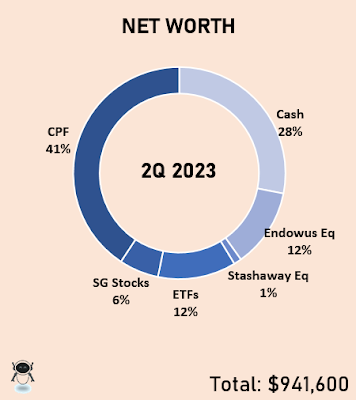
CPF: $383,400 (+$7,400) MA was topped up to BHS at the start of the year, while SA has exceeded FRS due to OA->SA transfer and RSTU over the past few years. Cash: $264,500 (+ $3,800 ) Consists of a combination of: Cash in UOB One, OCBC360 and DBS Multiplier Money market fund in robo cash management A small amount in SRS, awaiting allocation into Endowus ETFs: $113,500 (+$13,400) Both CSPX and QQQM saw quite a substantial gain this quarter Endowus: $113,500 (+24,000) My DCA portfolio for international exposure and tilt toward small cap, value, profitability and momentum. The portfolio consists Dimensional US Core Equity (25% of DCA amount) Global Core Equity  (25%) Global Targeted Value  (17%) Emerging Market Large Cap  (8%) Pacific Basin  (8%) Endowus 80% Equity 20% Bond managed portfolio (17%) Gain consists of capital injection of $18K and capital gain of $6K SG Stocks: 56,700 (-$4,700) Individual stocks with focus on dividend-paying companies. Most were purchase...

Making Decisions in an Uncertain World

Image
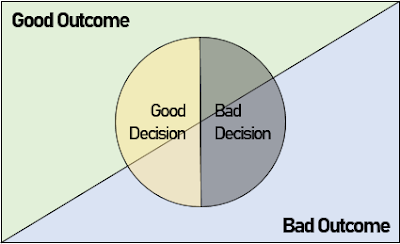
The stock market is inherently unpredictable. Even with detailed research and analysis, uncertainty cannot be eliminated. Yet, many investors still judge the quality of their decisions purely by the eventual outcome, even though that outcome could not have been known at the point of decision. Good Decisions Can Look Bad, and Bad Decisions can Look Good A poor decision (e.g., making an oversized bet on a highly speculative stock) can sometimes result in a strong payoff purely by luck. When this happens, the investor may mistakenly attribute the positive outcome to skill, reinforcing behaviour that is ultimately fragile and unsustainable. Conversely, a sound decision can produce disappointing results. Allocating capital to a broad, low-cost global equity index is supported by decades of evidence and is a rational strategy for long-term wealth accumulation. But in the short to medium term, markets can underperform expectations. If an investor judges their decision solely by these short-te...

Singapore's Struggling Stock Market

Image
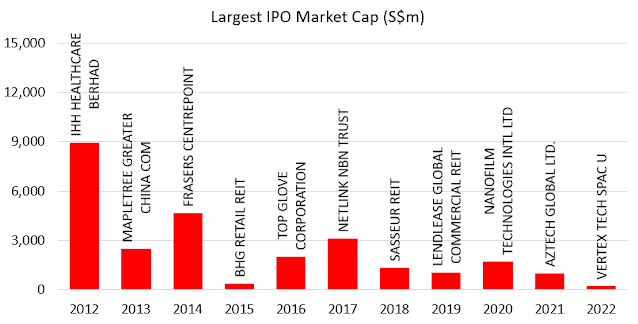
Singapore is a leading financial centre in Asia-Pacific, ranking third in the 2022 Global Financial Centre Index. This puts it behind only New New York and London, and ahead of our regional rival, Hong Kong. However, despite Singapore's status as a world-class financial hub, its local stock exchange market falls far behind other leading countries in raising capital. Falling average daily trading volume One of the most significant indicators of the health of a stock market is the average daily trading volume. In Singapore, this has been a steady decline for more than a decade. For example, the Security Daily Average Volume (SDAV) of the SG stock market fell from 1.6 billion shares (or $1.3 billion) to 1.1 billion shares (or $0.9 billion) in 2022. The lack of market participation and the resulting reduced liquidity and lower market efficiency can lead to a downward spiral of depressed prices and further reduced trading activity. Falling number of listed companies over the yea...