Posts

Showing posts with the label Investing

Using ChatGPT to Spot the Gaps in My Financial Plan

Image
I've always believed in taking charge of my own finances. I track my spending, plan for the long term and make deliberate investment choices. But even with a plan I'm confident in, it's easy to overlook blind spots, especially when you're too close to your own numbers. That's why I decided to run my financial plan through ChatGPT. I wanted a second opinion, something that could point out potential weaknesses without the bias of someone trying to sell a product. My goal was to see how AI would approach analyzing real-life financial plan, given all the details I could provide. Would it validate my strategy? Would it flag risks I hadn't considered? Most importantly, could it help fine-tune my path to financial independence (FI)? What was provided to  ChatGPT To make this review meaningful, I shared a full picture of my finances: Age: 35 Income from work: XX Annual expenses: XX Assets and liabilities: HDB flat valued at 650k, with 415k outstanding loan CPF: 33k (OA)...

The 4 Keys to Becoming a Successful Investor

Image
Many people believe success in investing hinges on timing the market or spotting undervalued stocks before anyone else. However, decades of data across numerous markets show that achieving this consistently is incredibly difficult, if not impossible. The path to successful investing lies in building the right mindset and strengthening your financial literacy. By focusing on long-term principles and developing habits that improve resilience and decision-making, you will be better equipped to navigate the ups and downs of the market and build wealth over time. 1. Conviction in Your Market and Long-Term Vision To succeed in any market, you must have conviction in the assets you invest in. Long-term success isn’t about quick wins—it’s about letting your investments grow, sometimes over years or decades. This means genuinely believing in the long-term growth potential of your investment. Conviction keeps you anchored when things get tough. For instance, during periods of high volatility or ...

The Flaws of a Dividend Investing Strategy

Image
Dividend investing is a popular strategy among investors seeking passive income. The idea of receiving regular cash payouts from investments is appealing but largely based on behavioural misconception that dividends are "free money" disconnected from capital value or share prices - a phenomenon known as the Free Dividend Fallacy   ( Hartzmark et al., 2018 ). The Dividend Disconnect To begin, it's crucial to understand of what dividends truly is. At their core, dividends reflect the capital allocation decision made by companies' management on how to deploy their earnings. They constitute payments made by a company to its shareholders from a portion of its profits, typically disbursed in the form of cash or additional shares of stock. These payments are typically paid regularly, often on quarterly basis. Dividend investors view this as companies paying out "free money" as an independent source of income, similar to payment from a bond. What they may fail to re...

Collective Wisdom of the Lazy Investors

Image
  I am a firm believer of low-cost diversified portfolios for long-term investing as this approach is backed by decades of empirical evidence and financial research. However, constructing our own diversified portfolio tailored to our investing preference and risk profile can be a challenging task. It involves meticulously identifying the suitable allocation to asset classes, geographical regions, and even the appropriate level of factor exposure. Questions like, "What percentage of my portfolio should be allocated to US small-cap value stocks?" can leave many investors scratching their head. Fortunately, many great investors and portfolio managers have developed a plethora of potential portfolios including Ray Dalio's All Weather Portfolio and Harry Browne's Permanent Portfolio that you may have heard of. A valuable resource in this regard is LazyPortfolioETF.com , a repository of over 100 "lazy" portfolios that can be easily implemented using a few ETFs and...

Singapore's Struggling Stock Market

Image
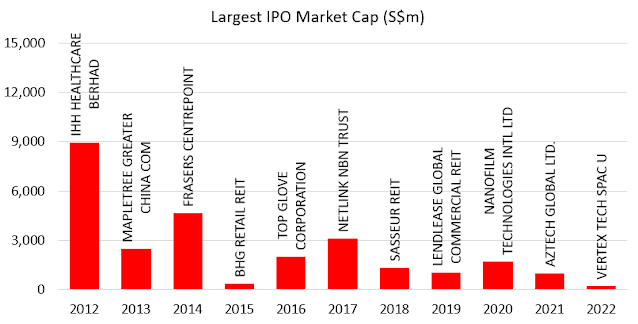
Singapore is a leading financial centre in Asia-Pacific, ranking third in the 2022 Global Financial Centre Index. This puts it behind only New New York and London, and ahead of our regional rival, Hong Kong. However, despite Singapore's status as a world-class financial hub, its local stock exchange market falls far behind other leading countries in raising capital. Falling average daily trading volume One of the most significant indicators of the health of a stock market is the average daily trading volume. In Singapore, this has been a steady decline for more than a decade. For example, the Security Daily Average Volume (SDAV) of the SG stock market fell from 1.6 billion shares (or $1.3 billion) to 1.1 billion shares (or $0.9 billion) in 2022. The lack of market participation and the resulting reduced liquidity and lower market efficiency can lead to a downward spiral of depressed prices and further reduced trading activity. Falling number of listed companies over the yea...

SPIVA: The Scorecard your Financial Advisor will never show you

Image
  When it comes to investing, many people who are less financial savvy turn to financial advisors (FAs) for guidance and advice. Ideally, FAs are expected to act in the best interests of their clients and provide them with recommendations that will best help them achieve their financial goals. However, in reality, there are self-serving FAs who prioritise their own interests over their clients', and this is unfortunately more common than we would like. For instance, FAs often promote investment-linked insurance plans (ILPs) because these products offer high commissions that the advisors can earn from selling them. They often touts the benefits of these professionally managed ILP funds which are managed by fund managers with years of expertise and experience in analysing markets and making investment decisions, and the flexibility to adjust their portfolios based on market conditions and outlook to help you earn higher returns. It sounds good, but none of these claims are backed by ...

Arguments against international stocks, and why I invest in them anyway

Image
ETF investors may have wondered whether they should add international stocks to their portfolio or stick with the S&P500. Proponents of international stocks highlight their lower valuations and potential diversification benefits as reasons to invest in them. However, well-known investors like Warren Buffet and Jack Bogle believes that non-US stocks are unnecessary. I do tell people, feel free to disagree with me because I'm not always right, but I have 0% in non-U.S. I say you don't need to have non-U.S., but if you do, limit it to 20%.   -- Jack Bogle, 2018 interview with Morningstar   Reasons to stick to US stocks   One of the reason why investors favour US over non-US is that the US stock market is considered one of the most efficient in the world, supported by sound financial institutions and governance as well as strong investor protection laws. The US economy is also highly diversified and includes a broad range of industries, making it more resilient against a...

ETF Investing: Lose Every Year, But Win Every Decade

Image
Investing in exchange-traded funds (ETFs) is an effective way for investors to diversify their portfolio and gain exposure to a broad range of investments. However, some folks may find it difficult to stick to this "boring" way of investing, particularly when they hear the extraordinary returns from other investments, be it Dogecoin, Arkk funds or technology stocks. This is understandable since many people like to compare themselves to others and may feel like they are missing out on phenomenal returns achieved by their peers in a short period of time. As an ETF investor, you need to accept that you will never be the number one investor on an year-on-year basis, not even close. But the good news is, over a period of several decades, you will almost always be better than majority of the investors who adopt a more active investment approach. Feel like you are missing out ETFs are designed to provide returns that are consistent with the market average. This means that they will ...

Red Flags: Why I avoid the Chinese Stock Market

Image
With the tremendous growth potential of Chinese stocks as the underlying narrative, many investors are eager to capitalise on the opportunity it presents. However, investing in the Chinese stock market comes with unique risks and challenges that investors must be aware of. Personally, I think the risks of investing in Chinese stock market outweighs the potential rewards, and Chinese stocks only make up of about 2% of my equity portfolio through my holding of Emerging Market Large Cap fund. In this blog post, I will share some of the key reasons why I hold such pessimistic view. Accounting and Transparency Issues Some Chinese companies may not adhere to the same accounting standards as their counterparts in other countries, making it difficult for investors to assess the true financial position of a company. For example, in 2020, Luckin Coffee, a Chinese coffee chain, was found to have fabricated sales figures and misled investors. The scandal led to a sharp decline in the company's...

Investing in the S&P 500? Why CSPX is the Preferred Choice for Singaporean Investors

Image
As a Singaporean investor looking to invest in the US stock market, choosing the right S&P 500 ETF can be a challenging decision given the large array of choices. Among the many S&P 500 ETFs available, I find the iShares Core S&P 500 UCITS ETF (CSPX) stands out as an excellent option for Singaporean investors. No Estate Duty Tax One of the most significant advantages of investing in CSPX is that it is not subject to estate duty tax. This is because it is domiciled in Ireland, which does not have an estate duty tax. In contrast, US-domiciled ETFs like the SPDR S&P 500 ETF (SPY) are subject to estate duty tax, which can be as high as 40%, for holdings in excess of US$60,000. Lower Dividend Withholding Tax (DWT) Another advantage of CSPX for Singaporean investors is the lower dividend withholding tax (DWT) rate compared to other S&P 500 ETFs . Dividend withholding tax is a tax levied on dividends paid by US companies to non-US investors. CSPX has lower DWT because...

Maximize your Returns with Portfolio Rebalancing

Image
Portfolio rebalancing is a crucial aspect of investing that helps investors maintain their desired asset allocation and manage risk. This process involves periodically adjusting the composition of an investment portfolio to ensure it remains aligned with the investor's goals and risk tolerance. Maintaining target asset allocation Market fluctuations and the performance of individual assets can cause your portfolio to drift away from your target allocation over time and your portfolio may become heavily skewed towards a particular asset class. Figure 1 shows the allocation drift of a 2-Fund portfolio that started with 60% US-Stock and 40% Long Term Treasury. The portfolio gradually shifted from 60-40 in 2003 to 82-18 by 2022 due to higher growth in the US stock market vis-a-vis the Long Term Treasury. Rebalancing your portfolio helps to maintain your desired asset allocation.    Figure 1. Allocation shift of a 60-40 portfolio over a 20-year period Managing risk Rebalancing ...

Why I'm not Convinced by Property Investment

Image
  Investing in property is one of the most popular choice for many people in Singapore, with the promise of high returns and stable investment being a major draw. The staunch belief that property is a 'sure-win' has been ingrained into many, especially for the older generation who witnessed the phenomenal rise in property value as Singapore transited from a third world to first. The recency bias due to the surge in housing prices over the past 2 years also reinforced this view. However, the reality of the property investment today may not be as rosy as portrayed by the media and real estate industry. Opaque costs of property investment Whenever I hear people share about their property gains, they only focus on two numbers: purchase price and selling price. However, when investing in property, there are many hidden costs to consider, including: Stamp Duty: A tax paid when purchasing a property, based on the purchase price or market value of the property, whichever is higher. Leg...