Posts

Showing posts with the label Personal Finance

Using ChatGPT to Spot the Gaps in My Financial Plan

Image
I've always believed in taking charge of my own finances. I track my spending, plan for the long term and make deliberate investment choices. But even with a plan I'm confident in, it's easy to overlook blind spots, especially when you're too close to your own numbers. That's why I decided to run my financial plan through ChatGPT. I wanted a second opinion, something that could point out potential weaknesses without the bias of someone trying to sell a product. My goal was to see how AI would approach analyzing real-life financial plan, given all the details I could provide. Would it validate my strategy? Would it flag risks I hadn't considered? Most importantly, could it help fine-tune my path to financial independence (FI)? What was provided to  ChatGPT To make this review meaningful, I shared a full picture of my finances: Age: 35 Income from work: XX Annual expenses: XX Assets and liabilities: HDB flat valued at 650k, with 415k outstanding loan CPF: 33k (OA)...

Reflecting on 2024

Image
2024 marked a year packed with personal milestones, from moving into my own house, celebrating my wedding, to crossing the coveted $1 million net worth mark. There were also difficult decisions to make, like overhauling my investment portfolio, investing when markets were at all-time highs and grappling with rising insurance premiums. Here's a brief recap that shaped my year: Major Expenses The largest expense this year was the renovation and furnishing of my new home which cost close to $90,000, slightly exceeding my initial budget. Being our first time going through this process, we were keenly aware of the many horror stories about renovation nightmares - be it unreliable contractors, hidden costs, or shoddy workmanship. While we thoroughly researched the contractors and IDs, there was always an element of luck. Fortunately, we managed to engage one that we were quite satisfied with. To manage costs, we opted to work with a main contractor instead of an ID. While this saved up ...

The 4 Keys to Becoming a Successful Investor

Image
Many people believe success in investing hinges on timing the market or spotting undervalued stocks before anyone else. However, decades of data across numerous markets show that achieving this consistently is incredibly difficult, if not impossible. The path to successful investing lies in building the right mindset and strengthening your financial literacy. By focusing on long-term principles and developing habits that improve resilience and decision-making, you will be better equipped to navigate the ups and downs of the market and build wealth over time. 1. Conviction in Your Market and Long-Term Vision To succeed in any market, you must have conviction in the assets you invest in. Long-term success isn’t about quick wins—it’s about letting your investments grow, sometimes over years or decades. This means genuinely believing in the long-term growth potential of your investment. Conviction keeps you anchored when things get tough. For instance, during periods of high volatility or ...

Net worth Update 3Q 2023

Image
CPF: $304,500 (-$79,000) The large drop in CPF was due to a downpayment for my  resale   HDB flat. Cash: $264,800  (+ $300 ) Consists of a combination of: Cash in UOB One, OCBC360 and DBS Multiplier Money market fund in robo cash management A small amount in SRS, awaiting allocation into Endowus ETFs: $111,100 (-$2,400) Both CSPX and QQQM moderated in 3Q23. Endowus: $130,800 (+17,300) My DCA portfolio for international exposure and tilt toward small cap, value, profitability and momentum. The portfolio consists Dimensional US Core Equity (25% of DCA amount) Global Core Equity  (25%) Global Targeted Value  (17%) Emerging Market Large Cap  (8%) Pacific Basin  (8%) Endowus 80% Equity 20% Bond managed portfolio (17%) Gain consists of capital injection of $18K and capital loss of $700 SG Stocks: 54,800  (-$1,900) Individual stocks with focus on dividend-paying companies. Most were purchased during my early foray into investing. Will reduce my exposure ...

Making Decisions in an Uncertain World

Image
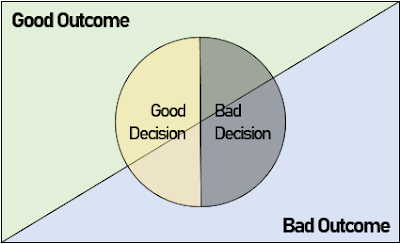
The stock market is inherently unpredictable. Even with detailed research and analysis, uncertainty cannot be eliminated. Yet, many investors still judge the quality of their decisions purely by the eventual outcome, even though that outcome could not have been known at the point of decision. Good Decisions Can Look Bad, and Bad Decisions can Look Good A poor decision (e.g., making an oversized bet on a highly speculative stock) can sometimes result in a strong payoff purely by luck. When this happens, the investor may mistakenly attribute the positive outcome to skill, reinforcing behaviour that is ultimately fragile and unsustainable. Conversely, a sound decision can produce disappointing results. Allocating capital to a broad, low-cost global equity index is supported by decades of evidence and is a rational strategy for long-term wealth accumulation. But in the short to medium term, markets can underperform expectations. If an investor judges their decision solely by these short-te...

How Robert Kiyosaki confused an entire generation

Image
"Is your house an asset or a liability?" is a question that can spark endless debate. Some argue that the answer depends on the situation and perspective, while others firmly believe that the definition is not subjective and wonder why there is room for debate. To properly address the question, we first need to know the difference between an asset and a liability. What is an asset?   According to Investopedia, an asset "is a resource with economic value that an individual, corporation, or country owns or controls with the expectation that it will provide a future benefit." Asset can be in the form of physical property such as a piece of land, inventory or equipment, and they typically depreciate over time due to wear and tear or expiration of legal rights. It can also be intangible such as patent, trademark, brand name, etc. Another class of asset is financial asset, which include stocks, bonds and cash. What is a liability? Liability is "something a person o...

Investing vs Speculating vs Gambling

Image
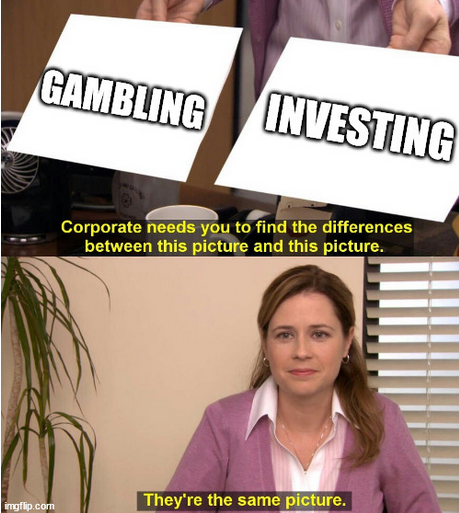
  Investing and gambling are sometimes discussed in the same context as they both involves putting money at risk with the goal of making a profit. To distinguish between the two, we first need to understand what is gambling. There are two main elements of gambling: 1. Gambling involves randomness and it is therefore risky 2. The expected return of gambling is negative (note, I'm excluding games like poker where the skill of the player can increase their chances of winner against other players). For example, the roulette at casinos has an expected return of -5.3%, which means for every $10 you bet, you are expected to get back only $9.47. The slot machine expected return is between -15% and -2% depending how the machine is configured. And Toto, our national favourite form of gambling, has an expected return of an abysmal -58%!! Like gambling, investing also carry risks. Changing market conditions, shifting demand and supply, new innovation etc. could influence the value of your inve...

Who is footing the bill of the generous credit card rewards?

Image
  Credit card rewards are a popular perks for consumers, offering generous signup bonuses, cash back, miles and other incentives for using a particular card. But have you ever wonder who is actually paying for these rewards? Before we answer that question, we need to know how credit card companies make money. There are typically 3 main sources of revenue, including: Interchange fees - fees that credit card companies charge merchants for accept credit card payments. These fees typical range from 1% to 3% of the transaction amount. Interest charges - fees that that credit card companies charge cardholder who carry a balance on their credit cards. These charges are typically in the range of 25% to 30%. Cash advance fees - fees on loans taken out against the credit limit of a credit card, which is typically 8% of the loan amount. There are also other sources of revenue such as annual fees and penalty fees, but they contribute less to the credit card companies income. A portion of th...

Adulting 102 - Investing & Insurance

Image
  In my previous post - Adulting 101: Saving, Spending & Taxes , we covered three key aspects of managing personal finances as and adult. In this post, we will discuss two additional aspects of adulting that are equally important - Investment & Insurance . Avoid common pitfalls in investing Investing is an effective way to build wealth and meet financial goals, but it is important to remember that investing carries risk . Therefore, it is important to manage your risk exposure and steer clear of excessive risk-taking. Here are some common pitfalls to avoid: 1. Not doing your due diligence Due diligence is a systematic process of analysing an investment decision. This include studying the stocks, sectors and geography that you are investing in. You should ask yourself questions such as, "What are the prospects of this investment?" and "What is the comparative advantage of the stock?" It is also important to consider the market outlook. Apart from finding conf...

Adulting 101 - Saving, Spending & Taxes

Image
  As a recent graduate in your early to mid-20s, you may have secured your first full0time job and are starting to build your life as an independent adult. However, with adulthood comes a range of responsibilities, including establishing a career, starting a family, raising child and taking care of ageing parents. Regardless of your commitments and aspirations, financial literacy is a crucial aspect of adulting, with long-term implications for various aspects of our lives. Being financially savvy can help us avoid financial hardship and reduce the likelihood of falling into financial distress . In this post, I will share my perspective on managing personal finances. Budget for your NEEDS first Calculate your essential expenses, such as transportation costs, food bills, insurance, utilities, telco bills, tax payment, parental allowance,to determine the amount you need to survive. While the percentage of take-home pay allocated to spending varies depending on individual financial sit...