Posts

The Flaws of a Dividend Investing Strategy

Image
Dividend investing is a popular strategy among investors seeking passive income. The idea of receiving regular cash payouts from investments is appealing but largely based on behavioural misconception that dividends are "free money" disconnected from capital value or share prices - a phenomenon known as the Free Dividend Fallacy   ( Hartzmark et al., 2018 ). The Dividend Disconnect To begin, it's crucial to understand of what dividends truly is. At their core, dividends reflect the capital allocation decision made by companies' management on how to deploy their earnings. They constitute payments made by a company to its shareholders from a portion of its profits, typically disbursed in the form of cash or additional shares of stock. These payments are typically paid regularly, often on quarterly basis. Dividend investors view this as companies paying out "free money" as an independent source of income, similar to payment from a bond. What they may fail to re...
Collective Wisdom of the Lazy Investors

Image
  I am a firm believer of low-cost diversified portfolios for long-term investing as this approach is backed by decades of empirical evidence and financial research. However, constructing our own diversified portfolio tailored to our investing preference and risk profile can be a challenging task. It involves meticulously identifying the suitable allocation to asset classes, geographical regions, and even the appropriate level of factor exposure. Questions like, "What percentage of my portfolio should be allocated to US small-cap value stocks?" can leave many investors scratching their head. Fortunately, many great investors and portfolio managers have developed a plethora of potential portfolios including Ray Dalio's All Weather Portfolio and Harry Browne's Permanent Portfolio that you may have heard of. A valuable resource in this regard is LazyPortfolioETF.com , a repository of over 100 "lazy" portfolios that can be easily implemented using a few ETFs and...

Net worth Update 2Q 2023

Image
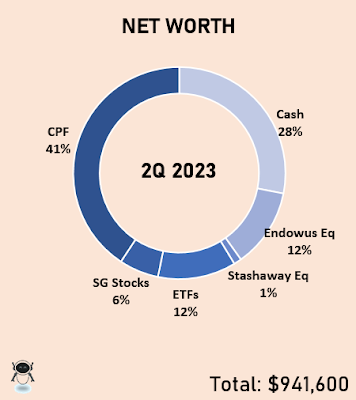
CPF: $383,400 (+$7,400) MA was topped up to BHS at the start of the year, while SA has exceeded FRS due to OA->SA transfer and RSTU over the past few years. Cash: $264,500 (+ $3,800 ) Consists of a combination of: Cash in UOB One, OCBC360 and DBS Multiplier Money market fund in robo cash management A small amount in SRS, awaiting allocation into Endowus ETFs: $113,500 (+$13,400) Both CSPX and QQQM saw quite a substantial gain this quarter Endowus: $113,500 (+24,000) My DCA portfolio for international exposure and tilt toward small cap, value, profitability and momentum. The portfolio consists Dimensional US Core Equity (25% of DCA amount) Global Core Equity  (25%) Global Targeted Value  (17%) Emerging Market Large Cap  (8%) Pacific Basin  (8%) Endowus 80% Equity 20% Bond managed portfolio (17%) Gain consists of capital injection of $18K and capital gain of $6K SG Stocks: 56,700 (-$4,700) Individual stocks with focus on dividend-paying companies. Most were purchase...

Making Decisions in an Uncertain World

Image
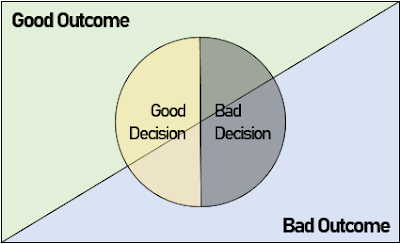
The stock market is inherently unpredictable. Even with detailed research and analysis, uncertainty cannot be eliminated. Yet, many investors still judge the quality of their decisions purely by the eventual outcome, even though that outcome could not have been known at the point of decision. Good Decisions Can Look Bad, and Bad Decisions can Look Good A poor decision (e.g., making an oversized bet on a highly speculative stock) can sometimes result in a strong payoff purely by luck. When this happens, the investor may mistakenly attribute the positive outcome to skill, reinforcing behaviour that is ultimately fragile and unsustainable. Conversely, a sound decision can produce disappointing results. Allocating capital to a broad, low-cost global equity index is supported by decades of evidence and is a rational strategy for long-term wealth accumulation. But in the short to medium term, markets can underperform expectations. If an investor judges their decision solely by these short-te...

Singapore's Struggling Stock Market

Image
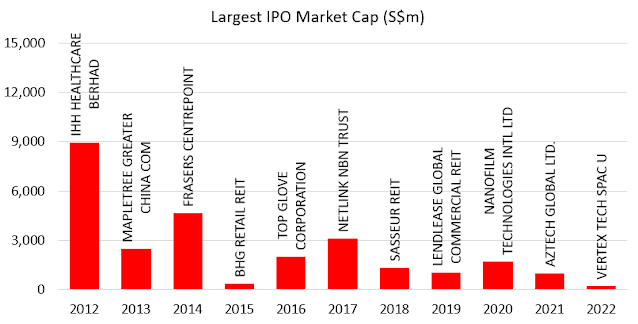
Singapore is a leading financial centre in Asia-Pacific, ranking third in the 2022 Global Financial Centre Index. This puts it behind only New New York and London, and ahead of our regional rival, Hong Kong. However, despite Singapore's status as a world-class financial hub, its local stock exchange market falls far behind other leading countries in raising capital. Falling average daily trading volume One of the most significant indicators of the health of a stock market is the average daily trading volume. In Singapore, this has been a steady decline for more than a decade. For example, the Security Daily Average Volume (SDAV) of the SG stock market fell from 1.6 billion shares (or $1.3 billion) to 1.1 billion shares (or $0.9 billion) in 2022. The lack of market participation and the resulting reduced liquidity and lower market efficiency can lead to a downward spiral of depressed prices and further reduced trading activity. Falling number of listed companies over the yea...

How Robert Kiyosaki confused an entire generation

Image
"Is your house an asset or a liability?" is a question that can spark endless debate. Some argue that the answer depends on the situation and perspective, while others firmly believe that the definition is not subjective and wonder why there is room for debate. To properly address the question, we first need to know the difference between an asset and a liability. What is an asset?   According to Investopedia, an asset "is a resource with economic value that an individual, corporation, or country owns or controls with the expectation that it will provide a future benefit." Asset can be in the form of physical property such as a piece of land, inventory or equipment, and they typically depreciate over time due to wear and tear or expiration of legal rights. It can also be intangible such as patent, trademark, brand name, etc. Another class of asset is financial asset, which include stocks, bonds and cash. What is a liability? Liability is "something a person o...

Investing vs Speculating vs Gambling

Image
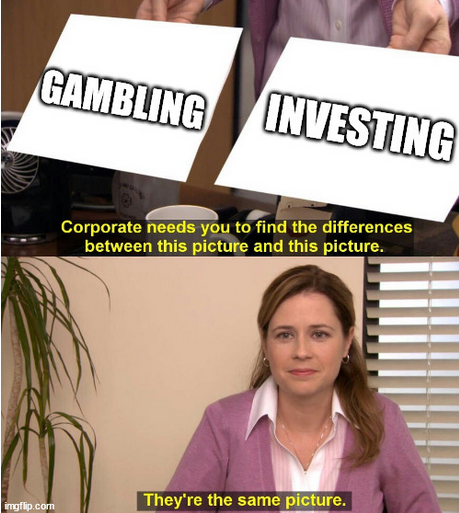
  Investing and gambling are sometimes discussed in the same context as they both involves putting money at risk with the goal of making a profit. To distinguish between the two, we first need to understand what is gambling. There are two main elements of gambling: 1. Gambling involves randomness and it is therefore risky 2. The expected return of gambling is negative (note, I'm excluding games like poker where the skill of the player can increase their chances of winner against other players). For example, the roulette at casinos has an expected return of -5.3%, which means for every $10 you bet, you are expected to get back only $9.47. The slot machine expected return is between -15% and -2% depending how the machine is configured. And Toto, our national favourite form of gambling, has an expected return of an abysmal -58%!! Like gambling, investing also carry risks. Changing market conditions, shifting demand and supply, new innovation etc. could influence the value of your inve...